India's Wide-Body Window
Where should Indian carriers deploy their next 100 long-haul aircraft, and can the India-Gulf corridor absorb them?
What it produced
- 78.0M
- India international sector passengers, 2025
- 8.5M
- a year connecting through a Gulf hub to elsewhere
- 4%
- of the order book Gulf treaty room could absorb
North America
+31.5%
Oceania
+29.5%
Europe
+21.3%
Africa
+16.9%
Southeast Asia
+11.2%
East Asia
+8.9%
South Asia
-1.9%
Gulf
-4.3%
Zero marks the baseline. Bars left of it are negative.
Yield headroom by corridor against IndiGo's achieved 5.06 INR per RPK, 2025. The Gulf carries 50.9% of India's international traffic and is the only corridor in the book with negative headroom, which is what turns the obvious deployment into the wrong one.
Source: Highlight 2 above, computed in the repository from DGCA sector data
Overview
A commercial aviation market-entry case built for a network and fleet strategy decision: where 60 A350-900s on firm order go first, and what to do with 40 unconverted purchase rights, against Air India's 80 wide-bodies, on a horizon through 2030. Evidence from DGCA, Eurostat, IATA and World Bank, every figure computed in the repository and none typed by hand, with no PowerPoint and no Excel anywhere in the pipeline.
The problem
The India-Gulf corridor carries half of India's international traffic and is four times the size of the entire direct Europe market, which makes it the obvious place to put a wide-body. The obvious answer turns out to be wrong, and the reasons only surface once the corridor's yield, its remaining treaty room and its sector lengths are computed rather than assumed.
The approach
Traffic, capacity and yield are rebuilt from DGCA sector data, then set against the firm order book to ask what the fleet can actually be deployed on. Yield headroom is computed per corridor against IndiGo's achieved revenue per RPK, remaining bilateral entitlement is measured against the aircraft on order, and 2030 demand is projected three separate ways and reported as a band rather than an average. The case ran on the opposite recommendation until three independent lines of evidence overturned it, and that reversal is written up in a pivot log rather than quietly amended.
What it found
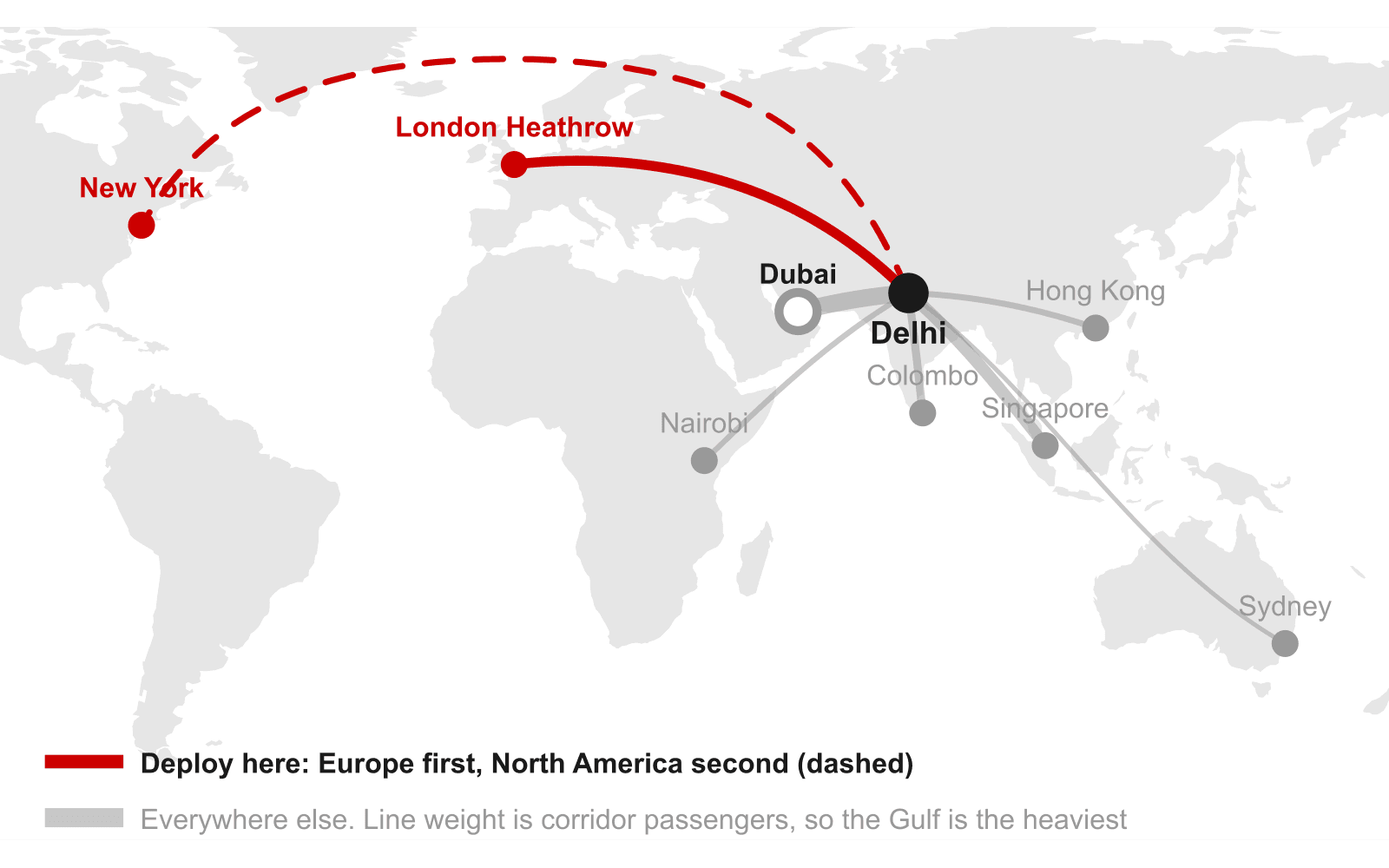
- The answer: compete with the Gulf hubs, do not fly more aircraft to them. Europe first, North America second, Gulf capacity roughly flat
- Yield headroom by corridor, 2025: North America +31.5%, Oceania +29.5%, Europe +21.3%, Africa +16.9%, Southeast Asia +11.2%, East Asia +8.9%, South Asia -1.9%, Gulf -4.3%. The Gulf is the only corridor that cannot cover its own cost at IndiGo's achieved 5.06 INR per RPK
- About 8.5M passengers a year are not going to the Gulf at all, they are connecting through Dubai, Doha or Abu Dhabi to somewhere else, a figure bounded below at 7.84M by IATA
- The remaining treaty room at the two Gulf points with a published entitlement would absorb about 4% of the aircraft on firm order, against an order book that adds 78% to Indian carrier international capacity
- IndiGo's average international stage length is 2,643 km against Air India's 5,316 km, so the fleet has to fly longer sectors before the wide-body economics work at all
- India international passengers in 2030 projected at 96M to 109M by three methods, reported as a band and never as an average
- The opening view was reclaim the Gulf corridor first. It was overturned by the evidence, and that reversal plus nine others is documented in a pivot log rather than quietly amended
Stack
- Python
- DGCA / Eurostat / IATA data
- Next.js
- Scrollytelling
- GitHub Actions